by Rami ben Ze'ev
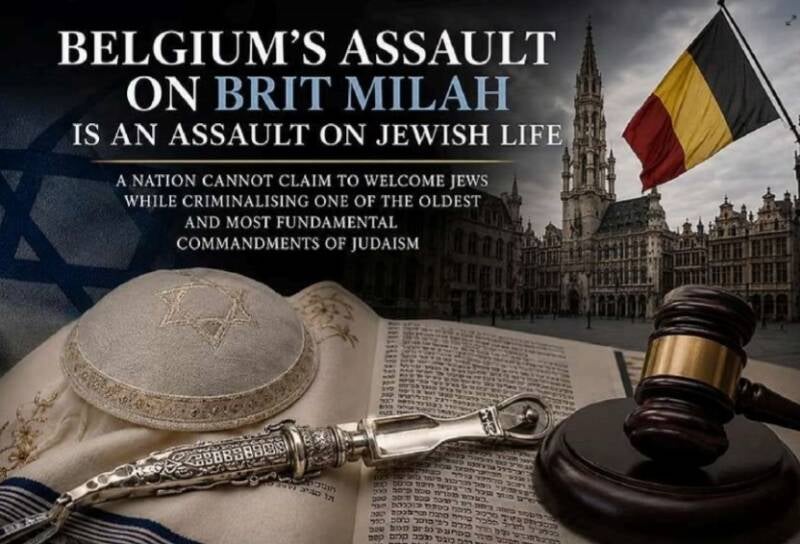
A nation cannot claim to welcome Jews while criminalising one of the oldest and most fundamental commandments of Judaism.
For more than eight centuries, Jews have lived in Belgium. They have contributed to its commerce, culture, scholarship, medicine, science, and public life. Today, approximately 30,000 Jews remain in the country. Yet many increasingly find themselves asking a difficult question: is there still a future for Jewish life in Belgium?
That question becomes more pressing when a state chooses to prosecute those who perform ברית מילה (Brit Milah – Covenant of Circumcision), one of the most ancient and sacred obligations in Judaism. The decision to pursue legal action against two mohalim is not merely a dispute over medical regulation or child welfare policy. It strikes at the heart of Jewish identity itself.
To understand why, one must understand what Brit Milah represents. This is not a custom, tradition, or optional religious ceremony. It is the physical sign of the covenant established between G-D and Abraham nearly four thousand years ago and reaffirmed throughout Jewish history. It predates modern states, modern medicine, and indeed many of the institutions that today seek to regulate it. Every Jewish community throughout the world, regardless of language, geography, or political circumstance, has regarded Brit Milah as one of the defining marks of Jewish continuity.
The Jewish people have maintained this commandment through exile, persecution, expulsions, inquisitions, pogroms, and even the Shoah. Empires rose and fell. Kingdoms disappeared. Borders shifted. Yet Jewish parents continued to bring their sons into the covenant of Abraham. The persistence of this practice is one of the reasons the Jewish people themselves have survived.
For that reason, attempts to prohibit or criminalise ritual circumcision are never viewed by Jews as neutral legal measures. They are understood as direct challenges to the ability of Jews to live as Jews. A government may insist that it is merely regulating a procedure, but the practical effect is far more significant. If a Jewish family cannot fulfil one of the most basic commandments of Judaism without fear of legal consequences, then the state is effectively telling that family that full Jewish observance is unwelcome.
The issue extends beyond circumcision itself. Across much of Europe, Jewish communities have witnessed a steady accumulation of pressures. Synagogues require security barriers and armed protection. Jewish schools operate behind fences and cameras. Jews increasingly report harassment in public, particularly when wearing visible signs of Jewish identity. Anti-Israel rhetoric often spills over into hostility toward local Jewish communities, despite those communities having no responsibility for the policies of a foreign government.
Each individual incident may be explained away as an isolated matter. Yet when viewed together, they create a troubling picture. A Jew looking at modern Europe sees a continent where security concerns are increasing, where public expressions of Jewish identity are becoming more difficult, and where fundamental religious practices are frequently challenged in courts and legislatures.
Supporters of restrictions on Brit Milah often argue that such measures are motivated by concern for children's rights. Yet this argument rarely acknowledges the extraordinary historical and religious significance of the practice. Nor does it explain why a procedure performed safely by trained practitioners for thousands of years should suddenly be regarded as incompatible with modern society. The result is that Jewish communities perceive these efforts not as balanced regulation, but as selective pressure placed upon minority faiths.
A liberal democracy should be capable of accommodating religious diversity without demanding that ancient communities abandon the practices that define them. True tolerance does not mean permitting religious expression only when it aligns perfectly with contemporary secular preferences. It means recognising that free societies contain people whose beliefs, customs, and obligations differ from those of the majority.
Belgium, like every European nation, must decide what kind of society it wishes to be. If it genuinely wishes to maintain a thriving Jewish community, then it cannot simultaneously place core Jewish observances under threat. The two positions are fundamentally incompatible.
The reality is simple. A country may regulate medical standards. It may ensure safety. It may establish professional requirements. But once it criminalises the performance of Brit Milah, it moves beyond regulation and into the realm of restricting Jewish life itself.
History teaches that Jewish communities rarely disappear overnight. Rather, they decline gradually as restrictions accumulate, confidence erodes, and families conclude that their future lies elsewhere. If Belgium wishes to avoid that outcome, it must recognise a basic truth: a nation cannot sincerely claim to welcome Jews while targeting one of the very commandments that has sustained Jewish existence for millennia.
Bill White ( Rami ben Ze'ev ) CEO of Jewish Dispatch Limited Mayside, UK