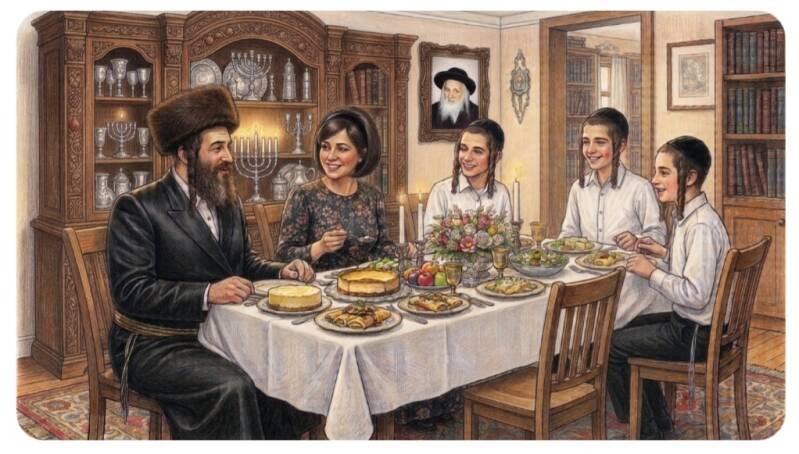
In a lively Williamsburg home filled with fresh greenery and dairy treats, Fraida and her family gather to celebrate Shavuos, reflecting on the gift of Matan Torah and the extraordinary devotion of Ruth, the Moabite princess who chose the Jewish people.
The apartment in Williamsburg was bright and festive, decorated with fresh green branches and blooming potted plants to remind everyone of Har Sinai bursting into flower when the Torah was given. Around the dining room table sat Fraida, her husband Yankel, with their youngest boys, Shraga and Shloime and Yoel enjoying a traditional Shavuos dairy meal of warm cheese blintzes and sweet kugel.
It feels amazing to finally reach Shavuos after counting all seven weeks of the Omer," Fraida smiled, passing a platter of blintzes to Shloime. "That’s literally what the word Shavuos translates to,- 'weeks.' Seven full weeks of preparation so we could be worthy of Matan Torah, the giving of the Torah."
"As the Torah commands in Vayikra perek 23," Yankel added, "'You shall proclaim on this very day, a holy calling it shall be for you.' Honestly, what could possibly be more important to Jews and Judaism than the giving and receiving of the Torah? Without Shavuos, there would be no Torah, and we wouldn't be Jewish. There would simply be nothing.
Shraga nodded thoughtfully, tracing the rim of his glass. "Chazal and Kabbalah teach that Shavuos is the moment of the eternal commitment- like a wedding-between HaShem and the Jewish people. All those weeks of Sefirah weren't just counting down days; they were a time for trust and love to grow deeper and stronger."
"And you feel that excitement in shul all morning!" Shloime chimed in eagerly. "First we say Hallel and Tehillim, then Akdamus glorifying HaShem, and then everyone stands up to hear the Aseres HaDibros read from the Torah. Plus, tomorrow on the second day, we also say Yizkor."
"And right before Musaf, we read Megillas Ruth," Yankel smiled. "Do you know the two reasons why we read Ruth on Shavuos?"
"The first reason is because the story takes place during the barley harvest, and Shavuos is the harvest festival!" Shraga answered quickly. "And the second, even more important reason, is Ruth herself, because she voluntarily chose to accept the Torah and become Jewish!"
"Yes," Yoel beamed. "Ruth’s story is one of the most moving journeys in all of Tanach. It happened back in the time of the Judges in Israel, when the Jewish people had grown lax in Torah observance and a famine struck the land. Elimelech, a wealthy merchant living in Judah who wasn't used to poverty, packed up his belongings with his wife Naomi and their two sons, and moved to the neighboring land of Moav."
"That’s where they met Ruth," Shloime said. "She was a Moabite princess!"
"Yes, she had every royal privilege," Yoel nodded. "Yet as Ruth got to know Elimelech’s family and learned about Jewish traditions and laws, she grew deeply dissatisfied with the idol-worship of her own people. She was drawn to something meaningful and true. When Elimelech’s son Mahlon asked her to marry him, Ruth accepted with pride and happiness, and she never felt a single regret about giving up her wealth and royal status."
"Then tragedy struck," Yankel said softly. "Elimelech and both of his sons passed away in Moav. Naomi decided to return home to Beis Lechem, and she urged her two daughters-in-law to stay behind in Moav and rebuild their lives. Why should they suffer in poverty with her? Orpah wept, kissed Naomi goodbye, and went back home."
"Yet Ruth refused to leave," Fraida said, her voice full of emotion. "She cried and begged Naomi not to send her away, speaking those immortal words: 'For where you go, I will go; and where you lodge, I will lodge; your people shall be my people, and your G-d my G-d; where you die, I will die, and there will I be buried; may HaShem do so to me, and more also, if anything but death parts you and me.' Even when Naomi reminded her of all the difficult mitzvos and challenges the Jewish people constantly face, Ruth stood completely firm."
And when they finally reached Judah during the harvest, Ruth immediately went out to the fields to find food for them," Schraga added.
"She walked into a field owned by Boaz, a noble leader of the generation," Fraida smiled. "Seeing her hesitating among the workers, Boaz spoke kindly to her: 'HaShem will be with you, stranger. Come into the field and gather grain to ease your hunger.' "And he didn't just give her handouts, he taught her the Torah’s laws of caring for the poor!"
"Like Pe'ah, Leket, and Shikchah!" Shloime said proudly. "I learned those in Yeshiva! Pe'ah means a farmer must leave the corners of his field uncut for the poor and the stranger. Leket means any stalks that drop during harvesting must be left behind for them. "And Shikchah means if a worker forgets a bundle of grain in the field, they aren't allowed to go back for it- it belongs to the poor!"
Exactly," Yankel smiled at his son. "Ruth gathered buckets full of grain, almost too heavy to carry, and brought them back to Naomi, who was overjoyed that Ruth had found such favor in Boaz's eyes. Eventually, with Naomi's encouragement, Boaz married Ruth."
"And look at the reward for Ruth’s pure devotion," Fraida concluded warmly, looking around at her family. "Ruth and Boaz were blessed with a son named Oved, who became the father of Yishai, and they both lived long enough to witness the birth of Yishai’s youngest son, our beloved Dovid HaMelech! "Every Shavuos, Ruth reminds us that accepting the Torah isn't just something that happened at Har Sinai thousands of years ago, it is a choice we make with love and commitment every single day."
"Speaking of love and commitment," Yankel grinned, reaching for the platter, "who wants seconds on those cheese blintzes?"
"Me!" Shloime and Shraga answered in unison, filling the room with laughter.