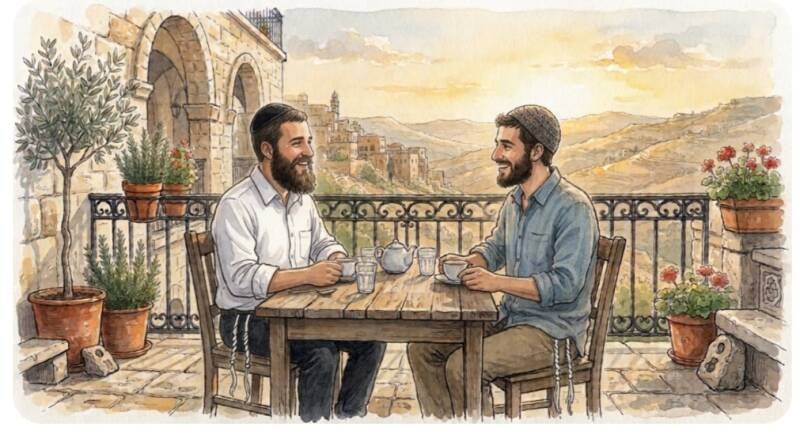
On a stone balcony overlooking the hills of Jerusalem, friends Tomer and Elkanah celebrate the New Year for Trees with fruits of the Holy Land, exploring the mystical meaning of the Seven Species and why hidden growth always comes first.
The late morning winter sun warmed the Jerusalem stone balcony where Tomer and Elkanah sat around a small wrought-iron table. Beyond the railing, terraced hills stretched out toward the Judean desert, full with olive groves and the very first pale pink blossoms of almond trees. On the table between them sat a vibrant platter of pomegranates, figs, grapes, dates, and olives.
Tomer picked up a date, smiling across the table at his friend. "Chag Sameach, Elkanah! Living here in Israel makes Tu BiShvat feel completely alive. In colder parts of the world, the 15th of Shevat happens while trees are still covered in snow, yet right here, you can actually see the almond trees starting to wake up and bloom."
That is because Tu BiShvas follows the exact agricultural rhythm of the Land of Israel," Elkanah smiled, reaching for a fig. "By the 15th of Shevat, most of the winter rains have already fallen and saturated the soil. Even before most trees show a single bud on the outside, the sap begins to rise inside their trunks, kicking off a brand-new cycle of fruit-bearing."
"It is amazing that the greatest renewal happens beneath the surface before anyone can see it," Tomer observed. "And to mark this day, we celebrate by eating fruits, especially the special kinds that the Torah praises the Holy Land for, like pomegranates, figs, grapes, dates, and olives."
Those are five of the Shiv'as HaMinim, the Seven Species for which the Torah praises Eretz Yisroel in Devarim," Elkanah nodded. "In Chabad teachings, each of these fruits represents a distinct emotional quality in how we serve HaShem. Grapes symbolize joy; figs represent deep engagement and learning; pomegranates symbolize overflowing mitzvos and good deeds; dates represent sweet, steady peace; and olives, which only give their pure oil when pressed, teach us resilience when life squeezes us."
Tomer looked down at the platter with fresh appreciation. "And before we enjoy any of them, we pause to recite the proper bracha."
"Always," Elkanah agreed. "Before eating fruit from a tree, we say 'Boruch Atah HaShem Eloheinu Melech HaOlam, borei pri ha'eitz'- blessing HaShem for creating the fruit of the tree. And if we include a brand-new seasonal fruit that we haven't tasted yet this year, we also get to recite Shehecheyanu, thanking HaShem for bringing us to this special moment. In fact, the Sages teach that eating a fruit without making a blessing is like taking something without permission, while saying a bracha connects both the fruit and ourselves directly back to our Creator."
Tomer paused, glancing out toward an ancient olive tree standing resiliently on the hillside below. "You know, Elkanah, the Torah compares a human being to a tree of the field. Why do you think Chassidic essays emphasize that comparison so much on Tu BiShvas?"
Because a tree has three essential parts, roots, a trunk with branches, and fruit," Elkanah explained. "Our roots are our emunah, our connection to HaShem and our heritage. Our trunk and branches are our Torah study and daily mitzvos. Yet the ultimate purpose of a tree isn't just to stand tall for itself; it is to bear sweet fruit, to inspire others, do kindness, and plant seeds that will keep growing for generations to come."
Tomer smiled, lifting a small handful of ruby-red pomegranate seeds. "Standing here in Jerusalem, surrounded by the very fruits the Torah praises, that message hits home like nowhere else."
"It truly does," Elkanah smiled, picking up a grape. "Let’s recite our bracha together and celebrate the New Year for Trees!"