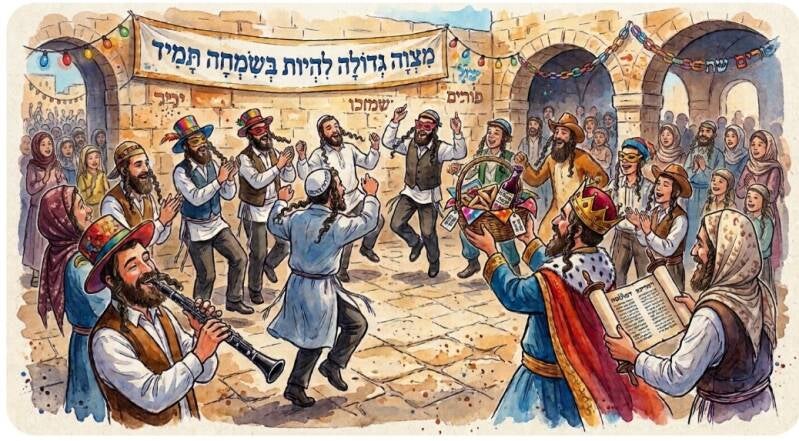
Amidst colorful gift baskets, hamantaschen, and costumes, friends Tiferet and Rivka sit down to talk about the dramatic history of Shushan, the four essential mitzvos of Purim, the sacred laws of hearing the Megillah, and Rebbe Nachman of Breslev’s timeless teachings on simcha, emunah, and transforming darkness into light.
The dining room table at Tiferet's house was overflowing with colorful ribbons, cellophane bags, baked hamantaschen, and small cartons of grape juice. Across from her, Rivka was carefully tying a gold bow onto a gift basket while both women chatted excitedly about the upcoming holiday, with the unmistakable melody of a Breslev niggun humming softly in the background.
You know, Rivka, every year when we pack Mishloach Manos, I think about Rebbe Nachman’s famous teaching: Mitzvah gedolah lihiyos b’simchah tamid- it is a great mitzvah to always be happy," Tiferet said, lining up a row of pastries. "And nowhere is that clearer than in how fast everything turns into the Purim story. Just one day before all this joy, on the 13th of Adar, we observe the Fast of Esther- a day of prayer, hisbodedus (personal conversation with HaShem), and teshuvah, remembering how Queen Esther and the Jewish people fasted and cried out to HaShem before she approached King Achashverosh."
Rebbe Nachman teaches that the deepest simcha is born specifically out of brokenheartedness and crying out to HaShem," Rivka smiled, setting down her scissors. "Look how quickly that fasting turned into victory! The timeline itself shows what Rebbe Nachman calls v’nahafoch hu -turning the darkest decree completely upside down. While the Jews across the rest of the empire celebrated their victory over their enemies on the 14th of Adar, the Jews inside the capital city of Shushan were still busy defending themselves and clearing the city of murderers and villains. It wasn't until the next day, the 15th of Adar, that the Jews in Shushan could finally rest and celebrate their salvation, which is why walled cities like Jerusalem still celebrate Shushan Purim on the 15th!"
And for the rest of us, the 14th of Adar became our permanent day of obligation and celebration," Tiferet nodded. "Rebbe Nachman teaches in Likutey Moharan that Purim joy has the power to shatter all sadness and bring down immense light, all centered around the four core mitzvos of Purim."
Rivka counted them off on her fingers with a grin. "First, of course, is hearing Megillat Esther read aloud in shul, both on Purim night and again on Purim day. Second is Mishloach Manos, sending at least two ready-to-eat food items to a friend to increase love, peace, and unity among us, which Rebbe Nachman says is the vessel for every blessing. Third is Matanos L'Evyonim, giving charity to at least two poor people on Purim day so everyone can celebrate, because giving tzedakah sweetens harsh judgments and awakens pure joy. And fourth is the festive Seudah, the Purim feast!"
Speaking of reading the Megillah," Tiferet leaned forward, intrigued, "I just read an incredible article in the Jerusalem Post about a 255-year-old Scroll of Esther! It’s amazing to think that the exact same words and laws we follow today have been preserved on parchment for centuries, just like Rebbe Nachman’s teachings stay fresh and alive in every generation."
It really is," Rivka agreed warmly. "And the laws of reading the Megillah are full of such beautiful details. First, both men and women are equally obligated to hear every single word read from a kosher parchment scroll written by hand by a sofer, not from a printed book. Rebbe Nachman places tremendous emphasis on hearing the words of Torah directly from a true kosher source with pure emunah. You also have to stand while the blessings are recited, and if you miss even one word, you can follow along in a printed Chumash until you catch back up to the reader."
"I love the custom of folding the Megillah before reading it too," Tiferet said. "Instead of rolling it like a Sefer Torah, the reader unfolds it like a personal letter- an iggeres- because the miracle of Purim feels like an intimate letter written directly to every single Jew across every generation, reminding us that HaShem never forgets us, no matter how far away we feel!"
That’s pure Breslev," Rivka smiled. "Rebbe Nachman always taught that every single person can speak directly to HaShem in their own language, and here HaShem sends us a personal letter right back! And right before the reader begins, everyone stands for the three special brachos. First is Al Mikra Megillah: 'Boruch Atah HaShem Eloheinu Melech HaOlam, asher kideshanu bemitzvosav vetzivanu al mikra Megillah.'
Second is She'asah Nissim," Tiferet continued, reciting the familiar words with feeling: "'Boruch Atah HaShem Eloheinu Melech HaOlam, she'asah nissim la'avoseinu bayamim haheim bazman hazeh'- thanking HaShem for performing miracles for our ancestors in those days, at this time. Rebbe Nachman reminds us that 'at this time' means right now, every single moment holds a miracle when we hold onto emunah."
And third is Shehecheyanu," Rivka concluded: "'Boruch Atah HaShem Eloheinu Melech HaOlam, shehecheyanu vekiyemanu vehigianu lazman hazeh'- thanking HaShem for keeping us alive, sustaining us, and bringing us to this special season. We say it at night, and in many customs we say it during the daytime reading too, keeping in mind all the other mitzvos of the day, the Mishloach Manos, the Matanos L'Evyonim, and the Seudah!"
Rivka looked down at the table full of gift baskets and smiled. "From fasting and crying out in hisbodedus on the 13th to hearing every word of the Megillah, giving tzedakah, sending food to friends, dancing, and feasting together, Purim takes every piece of our lives, even the hidden and broken parts, and turns them into pure light."
That’s the secret of Purim, and the secret of Rebbe Nachman," Tiferet said, handing Rivka another gold ribbon. "Even when HaShem’s name isn't mentioned once in the Megillah and His presence seems completely concealed behind masks and costumes, He is right there behind the scenes. As Rebbe Nachman says, Ein shum ye'ush ba'olam klal- there is no despair in the world at all! A Freilichen Purim!"