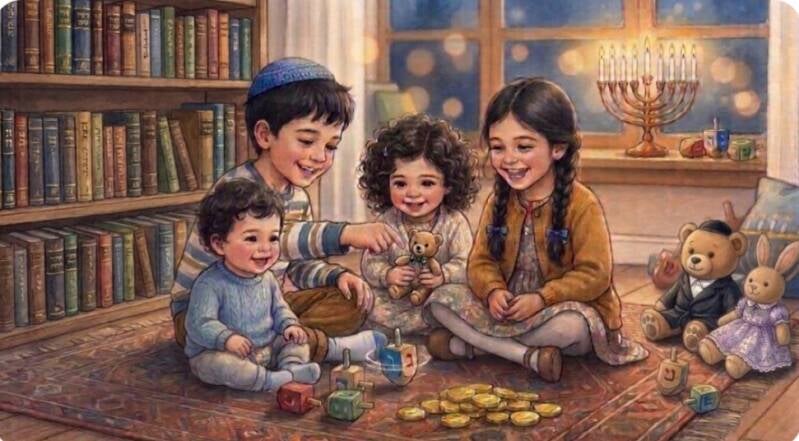
It’s Chanukah time, which means the menorah is glowing, the latkes are sizzling, and our living room floor is covered in tiny spinning dreidels.
If you ask the kids what a dreidel is, you’ll get four very different answers. Five-year-old Chayim will tell you it’s a high-speed battle top. Four-year-old Liora insists it’s a magical dancer. Three-year-old Rocheli believes it’s a snack delivery system (especially when chocolate gelt is involved), and 18-month-old Levi mostly thinks it’s a great thing to throw across the room.
While we love a good family game, the humble dreidel is actually packed with centuries of secret history and a spiritual meaning. Here is the story behind the spin, featuring our resident toy testers.
1. The Secret Code on the Sides
"Look, mame, ! Nun, Gimel, Hey, Shin!" Chayim announced proudly, pointing to the four Hebrew letters painted on his wooden dreidel.
Chayim knows his Alef-Beis, and he also knows the secret code those letters spell out: Nes Gadol Haya Sham, "A Great Miracle Happened There." It’s a tiny reminder of the miracle of Chanukah, when a tiny jar of oil burned for eight whole days in the Holy Beis HaMikdash.
2. A Clever Disguise
"Why is it a toy?" Liora asked, twirling around the living room to mimic her purple plastic dreidel. "Why didn't they just read a book?"
That’s where the real adventure begins. Over two thousand years ago, the Syrian-Greeks ruled the land and made a cruel law: Jewish people were forbidden from learning Torah. If anyone was caught learning, they faced severe punishment.
So, Jewish children and teachers got clever. They gathered in secret caves and hidden rooms to study. Whenever they heard the heavy footsteps of patrolling soldiers approaching, they quickly hid their scrolls and pulled out little spinning tops. To the soldiers, it just looked like an innocent game. Beneath the surface, it was an act of incredible bravery.
3. How We Play (The Gelt Economy)
Once Rocheli hears the crinkle of gold foil, the real focus begins. In our house, the rules of dreidel are serious business:
◽Nun (Nisht): Nothing happens. (Rocheli sighs dramatically.
◽Gimmel (Gantz): You get the whole pot! (Chayim does a victory dance.)
◽Hey (Halb):You take half the pot. (Liora carefully counts out the coins to make sure it's fair.)
◽Shin (Stell ayn): Put one in. (Levi happily drops a coin into the middle, and then tries to eat the rest of his pile.)
4. The Chabad Lesson: Getting Back Up
Every good dreidel spin ends the exact same way: it wobbles, slows down, and tumbles onto its side. When Levi’s dreidel fell over, he was trying to let it spin again.
In Chabad philosophy, that moment, right when the dreidel falls, is actually the most important part of the story.
When a dreidel spins, the letters blur together, hiding what’s really there. Just like the hidden miracles of Chanukah, we can't always see HaShem's hand clearly when life is spinning fast. And just like a dreidel inevitably falls over, we all have moments when we stumble, feel discouraged, or hit a low point.
The magic of the dreidel isn't that it spins forever; it's that you can always pick it back up by its handle and give it another spin. No matter how many times it falls, it’s designed to stand back up on its point and dance again.
So this Chanukah, as Chayim carefully plans to win his next big Gimel, Liora practices her twirls, Rocheli guards her chocolate gelt, and Levi launches his dreidel across the rug, I’m reminded of what the little ones really teaches us: keep learning, keep laughing, and whenever you take a tumble, just get back up and spin again.