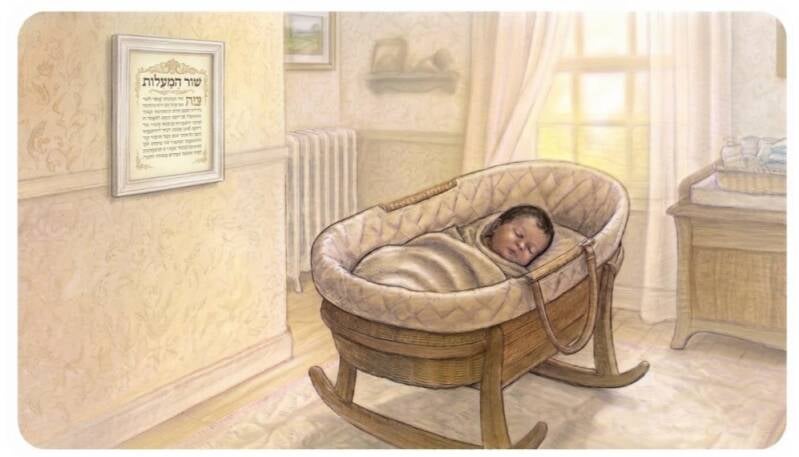
There is this wonderful time in the months spent waiting for a new life to arrive. Whether a pregnancy moves along or brings days that feels uncertain, I have always held one truth close to my heart: those nine months deserve to be wrapped in warmth, calm, and positivity.
Long before a baby ever opens their eyes to see us, they already feel the world we are building around them. Because children are such a precious gift, I find myself with so much thought into how we as both mother and father, can nurture that tiny soul from the very beginning.
In my experience, spiritual care starts long before the nursery is ready; it begins right in the womb. Keeping a peaceful home and nourishing the body with Kosher food create a foundation, yet it is a mother’s daily Mitzvahs and chesed that truly shape her baby’s spirit. Whenever I think about expectant mothers sewing a Torah sash during pregnancy, my heart feels so full. Imagine stitching love and prayers into fabric, knowing that if you are blessed with a son, that very sash will one day wrap around the Torah at his Bar Mitzvah, and again on the Shabbos before his wedding. It connects a mother’s hopes directly to the future of her child.
During pregnancy, leaning into faith stops feeling like a list of things to do and starts feeling like building a sanctuary. Opening Chumash to study, dropping coins into a Pushka, walking to Shul a little more often, and visiting the Mikveh as the due date draws near, all of it brings a sense of peace into our home. And I love how the father shares in this spiritual preparation, too, perhaps by taking a moment every single night before sleep to recite Tehillim 20. None of these practices are forced upon us, yet each one fills the waiting days with light and intention.
As the due date comes closer, our thoughts naturally goes towards family, specifically, the loved ones who came before us. In our tradition, we keep the memories of relatives, or our sages and great scholars,who have passed away alive by giving their names to our children. Even before the baby arrives, there is a sacred beauty in knowing how carefully that name will be spoken when the time comes.
Then comes the moment everything has been leading towards: labor begins. Suddenly, anticipation turns into action, hanging Shir Lamaalot (Tehillim 121) in the room, whether we are in the hospital or at home, and keeping it near mother and baby for those first three days feels like placing a shield over them. Our sages in the Talmud (Shabbos 129a), the Rambam, and the Shulchan Aruch remind us just how delicate childbirth truly is, so sacred and fragile that protecting the mother overrides even the laws of Shabbos. And when the moment of birth arrives, the father steps out of the room. Standing just outside that door, holding his breath and davening, makes the sound of that very first cry something he will carry in his soul forever.
In the overwhelming feeling of gratitude right after the baby arrives, words give voice to what the heart can barely hold. A father thanks HaShem by reciting HaTov VeHametiv upon the birth of a son, or Shehecheyanu the moment he lays eyes on his newborn daughter for the first time. Soon after, the door opens to some of the sweetest visits of all: the grandparents stopping by, eyes shining with simcha, leaning over the cradle to place hands on their new grandchild and whisper a bracha for a life of health, simcha, and Torah. And once the mother has regained her strength and returns to Shul, she too stands before the Torah to recite Birkas HaGomel, offering her own personal thank-you to HaShem for bringing her safely through the journey of childbirth.
From there, the days unfold into the sacred traditions of welcoming our child into Klal Yisroel, each path holding its own beauty:
When we are blessed with a daughter, the moment we have been waiting for usually arrives on the very first Shabbos after her birth. Just as a father gives his son a name, he has the honor of naming his daughter, so much so that if he happens to be away from home, we wait until he returns to give his daughter her name himself. Called up to the Torah in front of the community, he announces her name with care, making sure every syllable is pronounced clearly and accurately just as it is written in the Torah. Once her name has been spoken aloud, we surround the parents with warm wishes of Mazel Tov, davening that she grows to be zoche in HaTorah, L' Chuppah, and Ma'asim Tovim, naturally omitting the words spoken at a boy’s covenant ~ family and friends gather for a celebration in her honor.
When we welcome a son, the celebration begins even before the eighth day. On the very first Friday night after his birth, family and friends gather in the warmth of our home for a Shalom Zachor, a joyful Shabbos evening of singing, sharing Torah thoughts, and welcoming the little boy into the world with sweet treats and brachos.
Those first days lead directly towards the eighth day and the profound responsibility of the Bris Milah. Knowing that a father is entrusted with bringing his son into HaShem’s Covenant is humbling. Choosing a Mohel, someone who is not only knowledgeable in Jewish law and skilled in surgical hygiene, but who also carries the spiritual weight of the ritual, is a decision made and knowing that a purely medical procedure can never replace a true Bris.
Because the eighth day is sacred, we honor it right on time, ideally in the morning, even if it falls on Shabbos or Yom Kippur, counting carefully from sunset on the day he was born. Yet even in its strictness, Jewish law always puts life first: if a baby arrives early or isn't strong enough yet, the Shulchan Aruch instructs us to wait until he is completely healthy.
When the morning of the Bris arrives, it is filled with emotion. During the bris, a family member or friend is given the profound honor of serving as the Sandek, holding the baby in his lap. Having a Minyan present, including the father and the Mohel, elevates the Mitzvah and multiplies the simche in the room, though if circumstances ever make a full Minyan impossible, the Bris still goes forward with just the Mohel and the father standing side by side. It is during this sacred ceremony, now that his neshama has fully settled within him through the Covenant, reciting K'shem shenichnas la'bris.. , that our son is officially given his name. In that joyful moment, everyone calls out Mazel Tov! : "Just as he has entered into the Covenant, so may he enter into HaTorah, L'Chuppah, and Ma'asim Tovim ." After the bris, the day turns into celebration as everyone sits down together for a festive Seudah.
And when HaShem blesses us with a firstborn son, the very first child to open his mother’s womb, the story continues thirty-one days after his birth with: the Pidyon Haben, the Redemption of the Firstborn. In Torah tradition (when the baby is neither a Kohen nor a Levi, and was born naturally), the father brings his one- month-old son before a Kohen alongside five silver coins. In front of gathered family and friends, the father affirms how infinitely precious his child is, choosing to redeem his son with silver so he may grow up in his parents' home rather than be dedicated solely to Temple service. The Kohen accepts the coins, recite a bracha for the little boy with the priestly brachos, and returns him into his parents’ arms, followed, of course, by another joyful Seudah celebrating life, gratitude, and belonging.
Whenever I sit back and reflect on this journey, from the first flutter in the womb, through birth, naming, the eighth day, and the thirty-first day, I feel connected to an unbroken chain all the way back to Avraham Avinu. It is a promise kept across generations with love, faith, and devotion:
This is My Covenant which you shall keep, every male among you shall be circumcised, that shall be the sign of the Covenant between Me and you. At the age of eight days every male among you shall be circumcised throughout the generations, and the un-circumcised male shall be cut off from his people, he has broken My Covenant." ~ Bereshis 17: 10-14.