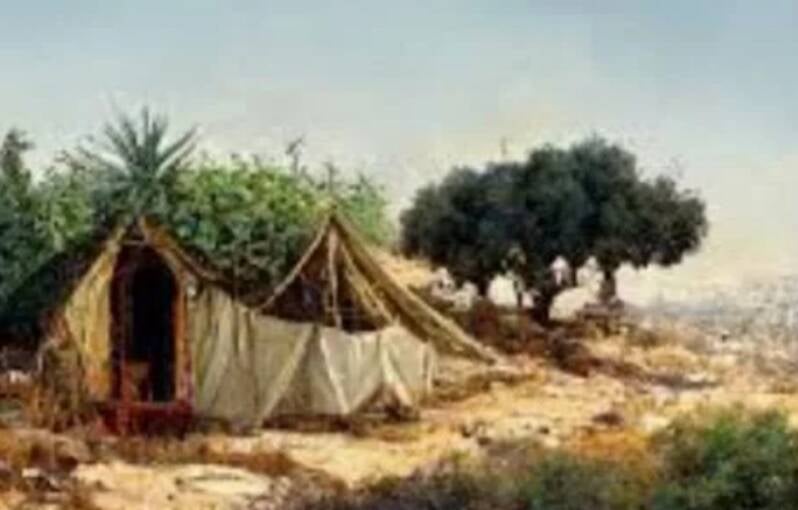
Every year, right after Rosh Hashanah and Yom Kippur, we do something kind of wild. We pack up our comfortable lives, step outside of our comfortable homes, and move into a hut with a roof made of branches.
Growing up, I always looked at Sukkos as a fun, cozy holiday. Eating meals in our Sukkah and hoped it wouldn't rain. But as I’ve got older and spent more time looking into Chassidus, I’ve realized something profound:
Sukkos is so much more than just a mitzvah to sit in a temporary shack. It’s about building a physical Dirah BeTachtonim, a dwelling place for Hashem’s ultimate essence to spend Sukkos with us within our lowest, physical reality.
The Divine Hug: The Light of Ohr Makkif
In Chassidus, there is a beautiful description of the Sukkah. When we do most mitzvos, like shaking a Lulav or putting on Tefillin, we use a specific part of our body, a localized Ohr Pnimi (internal light), to connect with HaShem. But the Sukkah is completely unique. It is one of the only mitzvos where you walk inside with your entire being. Muddy boots, everyday thoughts, and all.
The Sages call the Sukkah an Ohr Makkif, which is a surrounding transcendent light. The Lubavitcher Rebbe often brought down the idea that entering a Sukkah is like receiving a divine hug from Hashem. The walls encompass you completely, wrapping you in holiness from head to toe, elevating even the most mundane parts of who you are.
Hashem isn't just hugging us from the outside. He is moving in with us. And according to the Arizal, He brings the Ushpizin- the inner spiritual energies of our Patriarchs- to help us integrate this high light into our daily lives. On the first two nights, we unlock the core spiritual attributes (Middos) of Avraham and Yitzchak.
Drawing Down and Making Space: Avraham and Yitzchak
In Chassidus, Avraham and Yitzchak aren't just historical figures visiting our hut; they represent the two foundational movements of the soul required to connect with the Infinite.
Avraham is the embodiment of Chesed. His soul-movement was always outward, expanding, and giving. He represents our innate desire to love Hashem, to welcome the Divine light into the world, and to turn our physical space into an open tent of spiritual hospitality. On the first night of Sukkos, Avraham gives us the power of Ahavah to draw Hashem’s presence down into our physical reality.
On the second night, we shift from expansion to contraction with Yitzchak, who embodies Gevurah. Love alone isn't enough to build a home; you need walls. You need boundaries. Yitzchak represents Yirah and Bittul. It takes immense Gevurah to look at a beautiful brick home, voluntarily walk away from it, and declare that true security only comes from the HaShem. Yitzchak gives us the strength to contract our own ego so that the Divine light has room to dwell.
Without Avraham, we wouldn't have the passion to bring Hashem into our world. Without Yitzchak, our ego would take up too much space for Hashem to fit. Together, they create the perfect vessel.
Leaving the "Me" Behind for the "We"
When we leave our permanent homes, we are making a statement of Bittul. We are saying, "My security doesn't come from these brick walls. My wealth isn't what protects me. My real home is the Shechinah."
When we strip away the physical distractions of our regular houses, something amazing happens. We create a space completely cleared of our own Yesh (self-importance). Chassidus teaches that the moment we step out of our own ego, Hashem’s presence fills the void.
Our Sukkah literally becomes a Beis HaMikdash. A physical, earthly space where HaShem comes down to earth just to be with us because we finally made room for Him.
Bringing the Inside Out
This completely change how I look at sitting in the Sukkah. I'm not just eating dinner outside because the Torah told me to. I am hosting the Atzmus (the Essence) of the Creator in a temporary home we built together. When we laugh, share words of Torah, or just sing Chassidische niggunim around the table, we are turning everyday actions into a holy vessel.
Sukkos reminds us that Hashem doesn’t just want us to visit Him in Shul on Yom Kippur through a state of transcendent awe. He wants to live with us in our lowest, most mundane daily lives. He wants to be there when we eat, when we rest, and when we just having a good time with our family.
So this year, when you step inside your Sukkah, take a deep breath. Feel the Ohr Makkif around you. You aren’t just sitting in a Sukkah. You are sitting in Hashem’s Sukkah, fueled by the love of Avraham and the awe of Yitzchak, and He is so happy you’re there.