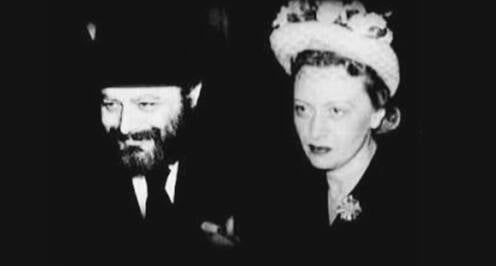
Yes, this is a beautiful and legendary chapter in Chabad history. The story takes place during
Rosh Hashanah 5702 (September 1941), just a few months after the Lubavitcher Rebbe, Rabbi Menachem Mendel Schneerson, and his wife, Rebbetzin Chaya Mushka (Moussia), narrowly escaped Nazi-occupied Europe and arrived in New York.
At the time, the Rebbe was not yet the leader of the movement; he was known simply as the "Ramash" (the son-in-law of the previous Rebbe, Rabbi Yosef Yitzchak). The American Jewish community was still largely unfamiliar with him, but this specific holiday would change everything.
The Chassidim Walk in Silence
On the first afternoon of Rosh Hashanah, it was time for the Chassidim gathered at the Chabad headquarters at 770 Eastern Parkway in Brooklyn to perform the traditional Tashlich prayer. They needed to walk a considerable distance from the synagogue over to Prospect Park to pray by the water.
In the 1940s, the American Chassidic community was very small and highly self-conscious. As the group of several dozen Chassidim stepped out onto the busy Brooklyn streets, they walked quietly, with their heads down, trying not to draw attention to themselves or their traditional attire from the secular onlookers. [1]
"This is Not a Way to Walk!"
Seeing the Chassidim walking almost apologetically, the Rebbe stopped the crowd on the parkway. He stepped to the front and boldly declared:
“This is not a way to walk to tashlich!”
With immediate energy, the Rebbe took command of the crowd. He split the tens of Chassidim—both the young students and the elderly elders—into two parallel, organized lines. He then stepped right into the center to lead them and burst out into a powerful, rhythmic Chassidic melody.
The Spark on Eastern Parkway
Instead of sneaking down the sidewalk, the Chassidim suddenly found themselves marching proudly down Eastern Parkway, heads held high, singing Jewish songs at the top of their lungs.
Thousands of curious, secular Brooklyn residents stopped on the sidewalks to watch the spectacle. Eyewitnesses recorded that it was a total revelation. One elderly, bareheaded Jewish man who had long abandoned his traditions rushed up to a student as the group marched back from the park. Pointing to his chest, he emotionally exclaimed that hearing the proud singing had instantly turned the faded spark of his Jewish identity into a roaring flame.
A Revolutionary New Era
This first Rosh Hashanah celebration effectively set the tone for the Rebbe’s entire future leadership. At a time when many believed European Chassidism was dead and could never survive the secular environment of the United States, the Rebbe used his very first New Year in America to demonstrate that Judaism should never be practiced in hiding or with shame.
The march to Prospect Park became an annual, joyous tradition. From that Rosh Hashanah onward, the Rebbe and Rebbetzin Moussia began their lifelong, revolutionary mission to revitalize worldwide Jewry with joy, pride, and radical optimism.